You have performed Ruqyah on yourself.
You have recited al-Baqarah.
You have made Du’aa, cried in Sujood, and begged Allah for relief.
Yet the heaviness remains. The whispers continue. The problem has not been lifted.
So now you begin searching for help. You start looking for a Raqi.
But the moment you begin searching, confusion sets in:
Who is genuine?
Who is a fraud?
Who might actually make things worse?
Some claim to heal with the Qur’an.
Others mix truth with superstition.
And some, may Allah protect us, are magicians disguised as healers.
This guide is written for you. For those sincerely seeking help while wanting to protect their faith.
In this article, we will cover:
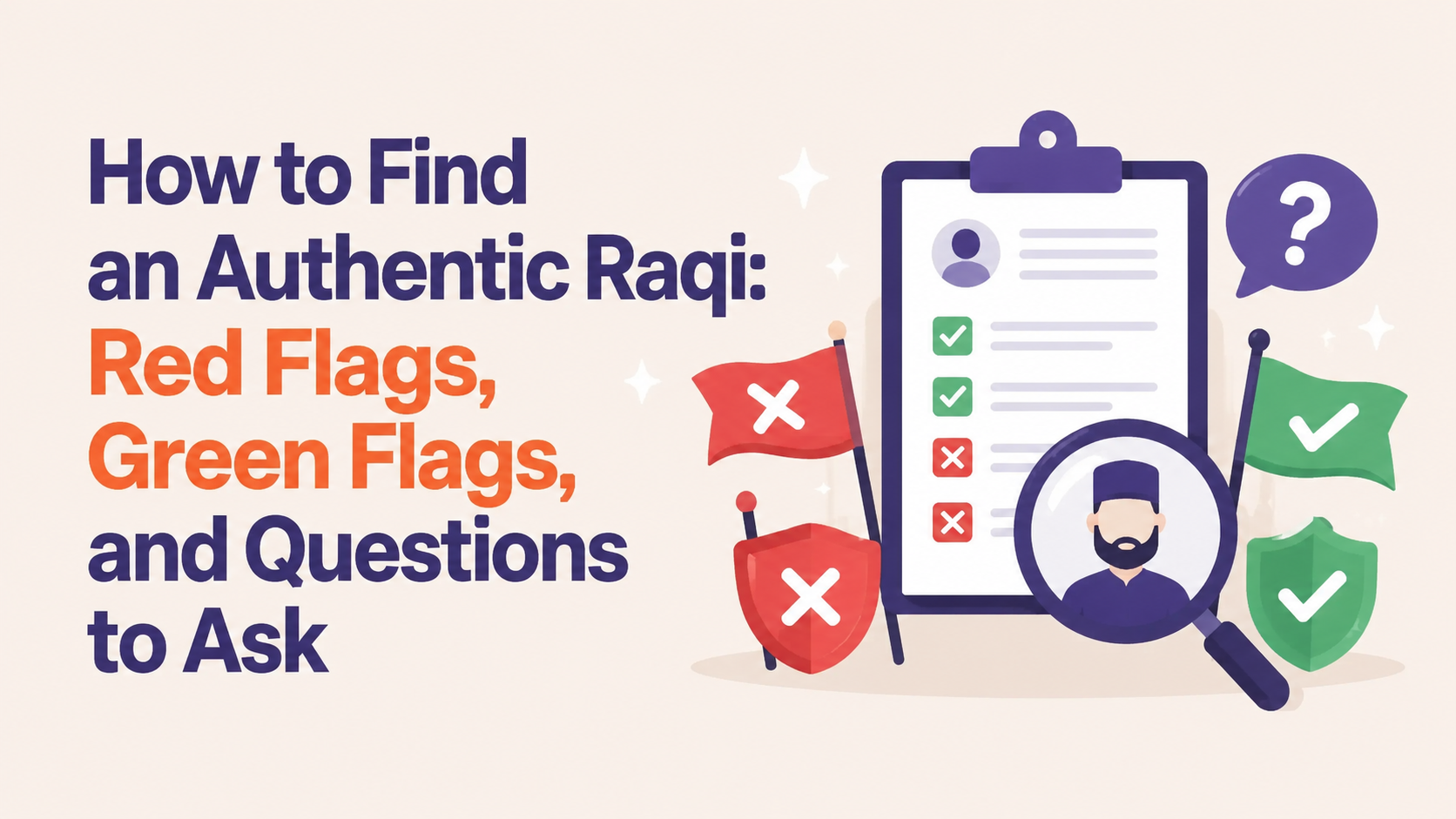
- The difference between a true Raqi, a fraud, and a magician
- Essential green flags to look for
- Major red flags to avoid
- Questions you should ask before booking a session
So you can seek Ruqyah with clarity and safety.
First: Know the Three Categories
Before looking for a Raqi, understand that not everyone offering Ruqyah is the same.
1. The Authentic Raqi
A true Raqi calls people to Allah.
He performs Ruqyah using the Qur’an and authentic supplications, asking Allah alone for cure.
He knows that healing comes only from Allah.
2. The magician, even if he claims to heal
This is the complete opposite of a Raqi.
A magician calls upon the Jinn and the Shaytan, even if he claims it is to remove magic or help you.
Let this be clear:
There is no white magic.
There is no breaking magic with magic.
Anyone using Jinn, talismans, unknown rituals, or secret practices is not healing you. They are harming you.
Allah said:
وَلَوْ أَشْرَكُوا لَحَبِطَ عَنْهُم مَّا كَانُوا يَعْمَلُونَ
But if they had associated others with Allah, then worthless for them would be whatever they were doing.
[Al-An’am 6:88]
If shirk destroys deeds, then how can healing come through it?
3. The fraud or rip-off
This is not a magician.
But not someone beneficial either.
They may read Qur’an, but:
- They do not follow authentic Ruqyah guidelines
- They waste your time and money
- They offer endless sessions with little real benefit
- They treat Ruqyah like a production line
A fraud does not always use magic. But they still harm by exhausting people emotionally, spiritually, and financially.
So how do we tell the difference?
Green Flags: Signs of an Authentic Raqi
1. Correct Aqeedah. This is the most important sign.
This is non-negotiable.
A Raqi must have sound Islamic beliefs. The same belief as the Prophet ﷺ and his
Companions.
Ruqyah is an act of worship, and what good is worship without the correct belief?
Allah said:
لَّقَدْ كَانَ لَكُمْ فِي رَسُولِ اللَّهِ أُسْوَةٌ حَسَنَةٌ لِّمَن كَانَ يَرْجُو اللَّهَ وَالْيَوْمَ الْآخِرَ وَذَكَرَ اللَّهَ كَثِيرًا
There has certainly been for you in the Messenger of Allah an excellent pattern for anyone whose hope is in Allah and the Last Day and [who] remembers Allah often.
[Al-Ahzab 33:21]
And:
وَمَا آتَاكُمُ الرَّسُولُ فَخُذُوهُ وَمَا نَهَاكُمْ عَنْهُ فَانتَهُوا
And whatever the Messenger has given you, take; and what he has forbidden you, refrain from…
[Al-Hashr 59:7]
Avoid completely:
- Non-Muslim healers
- Those who call upon saints, graves, or intermediaries
- Anyone seeking help from a Jinn
- Anyone whose beliefs you cannot clearly verify
Do not assume. Do not guess.
If you do not know their Aqeedah or you are unsure, do not go to them.
Allah said:
وَإِنَّ الظَّنَّ لَا يُغْنِي مِنَ الْحَقِّ شَيْئًا
Indeed, assumption does not avail against the truth in anything.
[An-Najm 53:28]
2. They strive to follow the Sunnah
A true Raqi tries to follow the Sunnah in their worship, character, and daily life.
If someone is careless about the Sunnah, introduces innovations, or mixes religion with cultural rituals, this will affect their Ruqyah.
The Prophet ﷺ said:
مَنْ أَحْدَثَ فِي أَمْرِنَا هَذَا مَا لَيْسَ مِنْهُ فَهُوَ رَدٌّ
Whoever introduces into this matter of ours that which is not from it, it will be rejected.
[Sunan Ibn Majah 14]
A person whose actions are rejected is not someone you should turn to for spiritual cure.
3. Upright practice and avoidance of open sin
A Raqi should be a practising Muslim.
They pray.
They avoid major sins.
They do not openly disobey Allah.
Everyone makes mistakes.
But open, shameless sin is different.
If someone openly:
- Neglects prayer
- Swears constantly
- Lives in public disobedience
How can they recite the words of Allah over you while openly and shamelessly disobeying Him?
4. Strong trust in Allah
A real Raqi believes firmly that Allah alone cures.
Allah says:
وَمَن يَتَوَكَّلْ عَلَى اللَّهِ فَهُوَ حَسْبُهُ
Whoever puts their trust in Allah, He will be sufficient for them…
[At-Talaq 65:3]
They do not act like they are the source of healing.
They remind you that the cure comes only from Allah.
They have good expectations of Allah and encourage you to have the same.
5. They remember Allah often
This is a major green flag.
Someone constantly engaged in Dhikr, Qur’an, and remembrance of Allah is far more likely to bring benefit.
A Raqi who lives with the Qur’an and Dhikr is a strong positive sign.
6. Firm belief that the Qur’an is a cure
The Qur’an itself is a cure, and this is essential:
وَنُنَزِّلُ مِنَ الْقُرْآنِ مَا هُوَ شِفَاءٌ وَرَحْمَةٌ لِّلْمُؤْمِنِينَ ۙ وَلَا يَزِيدُ الظَّالِمِينَ إِلَّا خَسَارًا
And We send down of the Qur’an that which is healing and mercy for the believers, but it does not increase the wrongdoers except in loss.
[Al-Isra 17:82]
A real Raqi has absolute conviction that the Qur’an is a cure for every illness, whether physical, spiritual, or psychological.
If someone believes:
- This case is too strong
- This magic cannot be broken
- The Qur’an may not be enough
Then this is a major problem.
The Qur’an is a complete cure. The stronger the belief in it, the more effective the Ruqyah.
7. Reasonable and sincere approach to money
The best of people are those who do Ruqyah without charging.
But it is permissible to take payment.
Green flags when it comes to this are if they take payment when:
- It is their livelihood
- It is reasonable
- It is not exploitative
Warning signs include:
- Extremely high fees
- Charging per minute aggressively
- Treating patients like a factory line
- No care or follow-up
- Only concerned with payment
A sincere Raqi cares about your well-being, not just your wallet.
Red Flags: Signs to Avoid Immediately
1. Any form of shirk in Ruqyah
If they:
- Call upon Jinn
- Use talismans
- Invoke a righteous person
- Use unknown symbols
Leave immediately.
There is no situation where Shirk brings cure.
2. Unknown or secret practices
If you cannot clearly understand what they are doing, do not go to them.
Examples:
- Writing unknown symbols and telling you to drink them
- Whispering things you cannot hear
- Performing strange rituals
If you do not fully understand what they are doing, do not proceed.
What is unclear is dangerous.
3. Claiming special powers or secret knowledge
Be very cautious of anyone who says:
- I have a special/Muslim Jinn who helps me
- I know hidden things
- Only I can treat this case
- Your case is too strong for others
This language often leads to deception or worse.
4. They openly justify magic or come from circles known for practising it
If someone believes magic can be used for good or that it is acceptable in certain situations, this alone is enough to avoid them.
Be extremely cautious of anyone who:
- Says magic can be used to break magic
- Comes from groups widely known for occult practices
- Downplays the seriousness of Sihr
Some practitioners may not openly admit to performing magic, but their beliefs make it clear that they tolerate or accept it. Anyone whose understanding allows magic or cooperation with Jinn treatment should be treated as a magician, not a healer.
Correct belief protects a person from falling into these practices. When the belief itself is compromised, the methods usually follow.
5. They show signs of a connection to Shaytan or the unseen
Another clear sign to walk away is any suggestion that the practitioner has a relationship with unseen forces.
This includes statements such as:
- Unseen beings inform me about cases
- I receive messages or signals
- I can sense or communicate with entities
- Forces or spirits assist me in diagnosis or treatment
It does not matter what name they use for the treatment. If a person offering help is known to have any kind of connection to Jinn or unseen forces, they should be avoided completely.
Anyone who presents themselves as having special access to the unseen or a working relationship with hidden entities falls into the category of magicians rather than authentic practitioners.
6. They ask for the mother’s name or personal details unrelated to treatment
One of the most well-known signs of a magician is asking for specific personal details that have no clear relevance to Ruqyah.
Be extremely cautious if someone asks for:
- Your mother’s name
- Your date or place of birth (without a clear medical/admin reason)
- Photos of you or family members for “diagnosis”
- Items of clothing, hair, or personal belongings
- Names of family members unnecessarily
Particularly, asking for the mother’s name is historically recognised as a sign of magicians. These details are often used in occult calculations or methods connected to Sihr.
There is no need for such information in authentic Ruqyah.
A genuine Raqi treats using the Qur’an, supplications, and clear methods. They do not need hidden personal data to recite over you.
If a practitioner insists on these details as part of treatment, it is safest to leave immediately and seek someone else.
Questions You Should Ask a Potential Raqi
Before committing to sessions, ask clearly:
- What is your Aqeedah?
- What exactly do you recite or do in Ruqyah?
- Do you use anything besides the Qur’an and authentic Du’aa?
- Do you involve Jinn in any way?
- How do you charge, and what are your fees?
- Will you encourage me to perform Ruqyah on myself?
A genuine Raqi will answer openly and comfortably.
If someone becomes defensive or vague, take that as a warning.
Final Advice: Do Not Forget Yourself
Before seeking a Raqi, continue Ruqyah on yourself.
Your connection with Allah is the strongest protection you have.
Increase:
- Salah
- Qur’an
- Dhikr
- Tawbah
- Trust in Allah
- Du’aa
Often, the greatest cure begins when a person turns back fully to their Lord.
Ask Allah sincerely for guidance to someone genuine.
And ask Him for a cure directly, for He alone heals.
May Allah protect you from deception, grant you clarity, and grant complete Shifa.
If you found this beneficial and would like to explore the topic of Ruqyah further, register for our FREE masterclass on authentic, evidence-based Ruqyah by Muhammad Tim Humble.
It will help you learn the correct approach a Muslim should take when seeking a cure for issues such as the evil eye, Jinn possession, magic (Sihr), and other ailments.